
Archive Record
Images
Metadata
Catalog Number |
1987.3.0465 |
Title |
[Reel-to-reel tape recorded by Louis Armstrong] |
Object Type |
Tape |
Collection |
Louis Armstrong Collection |
Description |
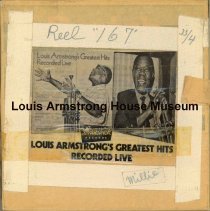
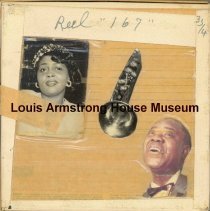
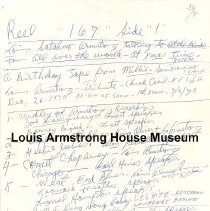
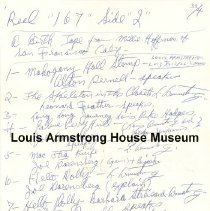
Scope: "The Night Before Christmas." Armstrong radio tribute from San Francisco. Back of tape box includes a photo of Lucille Armstrong. Originally meant to be cataloged in ”Tape Catalog #2, Part 1” (see Manuscripts, 1987.2.23), but Louis passed away before entering it. Contents (as on compact disc reference copy): Disc 1, Tracks 1-2: "The Night Before Christmas" (Louis Armstrong, in his den on February 26, 1970; each version is different than the released version, which edited the best parts of both together); Tracks 3-37: Recording of Louis Armstrong tribute radio broadcast by Chuck Cecil on "The Swinging Years," originally broadcast on July 2, 1970 and rebroadcast on December 26, 1970 (sent to Louis by Millie Hoffman): Cecil opens the show, mentioning this is a rebroadcast; "When It's Sleepy Time Down South" (Louis Armstrong); Track 4; Cecil opens broadcast with a medley of excerpts of Louis's hits; Cecil says the story begins in New Orleans; Track 5: Joe Darensbourg speaks about New Orleans; Track 6: Barney Bigard talks about New Orleans food (red beans and rice); Track 7: Cecil talks about Bigard and Darensbourg joining Louis; Darensbourg talks about Armstrong's musical training; Lorenzo Tio, Alphonse Picou; Darensbourg talks about first seeing Louis with Oscar Papa Celestin's band; Track 8: Barney Bigard talks about Louis at the Colored Waif's Home; being called Satchelmouth; Track 9: Peter Davis; Darensbourg talks about Buddy Petit; King Oliver; Track 10: Kid Ory talks about Louis playing in his band; (on recording, Ory asks Louis when he joined; Louis says 1918, with Jimmie Noone); Louis talks about going to Chicago to play with Oliver; Track 11: "Dippermouth Blues" (King Oliver); Track 12: Louis talks about Oliver; Track 13: Cecil talks about Louis's playing in Chicago; Louis talks about putting the cornet down in 1925 when he joined Erskine Tate's symphony orchestra; Track 14: The Hot Five; Darensbourg talks about importance of Louis's records; Track 15: "Heebie Jeebies" (Louis Armstrong and His Hot Five); Track 16: Alton Purnell talks about Armstrong's genius; Track 17: "Cornet Chop Suey" (Louis Armstrong and His Hot Five); Track 18: Earl Hines talks about Louis; Track 19: Hines talks about meeting Louis at the Sunset Cafe; Track 20: Hines talks about how they had no idea their recordings were going to have any effect; talks about introduction of "West End Blues"; Track 21: "West End Blues" (Louis Armstrong); Track 22: Leonard Feather talks about "West End Blues"; Hines talks about how none of the musicians paid attention to the recordings they made; Track 23: Hines talks about getting paid to make the records; respect they received; Track 24: Lionel Hampton talks about playing with Les Hite at Sebastian's Cotton Club; Hampton talks about Louis playing with them; making records together; Track 25: "I'm a Ding Dong Daddy" (Louis Armstrong); Track 26: Hampton talks about hearing that record ("like being in paradise"); Hampton praises Louis; Track 27: Bigard talks about Louis's radio broadcasts from the Cotton Club; Track 28: Alton Purnell praises Louis; Louis reminiscing about New Orleans; Track 29: Earl Hines talks about Louis playing his horn "from his heart"; Track 20: "Lawd, You Made the Night Too Long" (Louis Armstrong); Track 21: Leonard Feather talks about Louis's reception in Europe in the 1930s; Track 32: "When It's Sleepy Time Down South" (Louis Armstrong); Cecil ends this part and foreshadows part 2; Track 33: Station ID (incomplete); Track 34: Cecil talks about having some time to kill before rebroadcasting the second part; Track 35: Cecil continues part two, talking about Louis's 1930s recordings; Alton Purnell talks about Louis's smile; "Medley of Armstrong Hits: When You're Smiling, St. James Infirmary, Dinah" (Louis Armstrong); Track 36: Louis talks about Luis Russell band with Pops Foster, Red Allen and Albert Nicholas"; Track 37: "Mahogany Hall Stomp" (Louis Armstrong); Disc 2, Tracks 1-17: Continuation of Chuck Cecil's 70th birthday tribute broadcast on Louis: Louis talks about Luis Russell band; Track 2: "Mahogany Hall Stomp" (Louis Armstrong); Track 3: Cecil talks about Decca recordings of the 1930s; Purnell talks about Louis's goal of pleasing the public; Track 4: "The Skeleton in the Closet" (Louis Armstrong); Track 5: Cecil talks more about Decca recordings; Louis being an Esquire All-American Award winner; Track 6: Feather talking about Louis's influence; Feather talks about "Downbeat" 70th birthday tribute; Track 7: "Long Long Journey" (Louis Armstrong with 1946 Esquire All-American award winners); Track 8: Cecil talks about previous record featuring Louis, Duke Ellington and Johnny Hodges; Louis talks about recording "Blueberry Hill" with Gordon Jenkins; Louis says the other side, "That Lucky Old Sun," was supposed to be the hit; "Blueberry Hill" (Louis Armstrong); Track 9: Joe Darensbourg talks about being with Louis in San Francisco when Louis's car was stuck; Louis had to push Darensbourg's Ford, laughing the whole time; Track 10: "Mack the Knife" (Louis Armstrong); Track 11: Louis talks about "Mack the Knife" being a big number in Africa; going all over the world; Darensbourg talks about Louis loving everybody; the horn comes first, then Lucille; Barney Bigard talks about Louis in Europe; Bigard talks about Louis's audience with the Pope in 1949 ("Have you any children" story); Track 12: Louis talks about "Hello, Dolly!" being a hit song; "Hello, Dolly!" (Louis Armstrong); Track 13: Louis talks about "Hello, Dolly!"; Track 14: Darensbourg talks about the "Hello, Dolly!" recording session; Billy Kyle sketched out a little arrangement; went on the road and forgot about it; road manager called to say it was making the charts; Louis had the band boy get an arrangement and they didn't have it either; Track 15: "Hello, Dolly!" (Louis Armstrong and Barbra Streisand); Track 16: Purnell, Darensbourg and Bigard have closing tributes to Louis; Darensbourg says they're trying to put a statue up for Louis; says Dizzy Gillespie was the first one who mentioned it; Track 17: "When It's Sleepy Time Down South" (Louis Armstrong); Track 18: Cecil closes the show and wishes Louis a "Happy Birthday"; trumpet solo on "When It's Sleepy Time Down South"; Tracks 19-29: Recording of "The David Frost Show," aired February 10, 1971, with Louis Armstrong and Bing Crosby: show opening by Frost; theme song; Track 20: Frost introduces Bing Crosby; Track 21: Frost introduces slide show of photos set to "Where the Blue of the Night"; Track 22: "Where the Blue of the Night" (Bing Crosby); Track 23: "White Christmas" (Bing Crosby); Track 24: Frost introduces Louis; "When It's Sleepy Time Down South" (Louis Armstrong); Track 25: "Blueberry Hill" (Louis Armstrong and David Frost); Track 26: "That's My Desire" (Louis Armstrong and Tyree Glenn); Track 27: "Boy from New Orleans" (Louis Armstrong); Track 28: closing theme; Track 29: Frost promo for the show. |
Tape Information |
Reel 167 according to original tape contents sheet found in box (c. 1970-19 |
People |
Bigard, Barney Cecil, Chuck Crosby, Bing Feather, Leonard Frost, David Glenn, Tyree Hampton, Lionel Hines, Earl Hoffman, Millie Purnell, Alton |
Search Terms |
David Frost Show, The (television program) San Francisco |
Year Range from |
1971 |
Year Range to |
1971 |
Creator |
Louis Armstrong |
Caption |
1987.3.465 Front |
Accession number |
1987.3 |